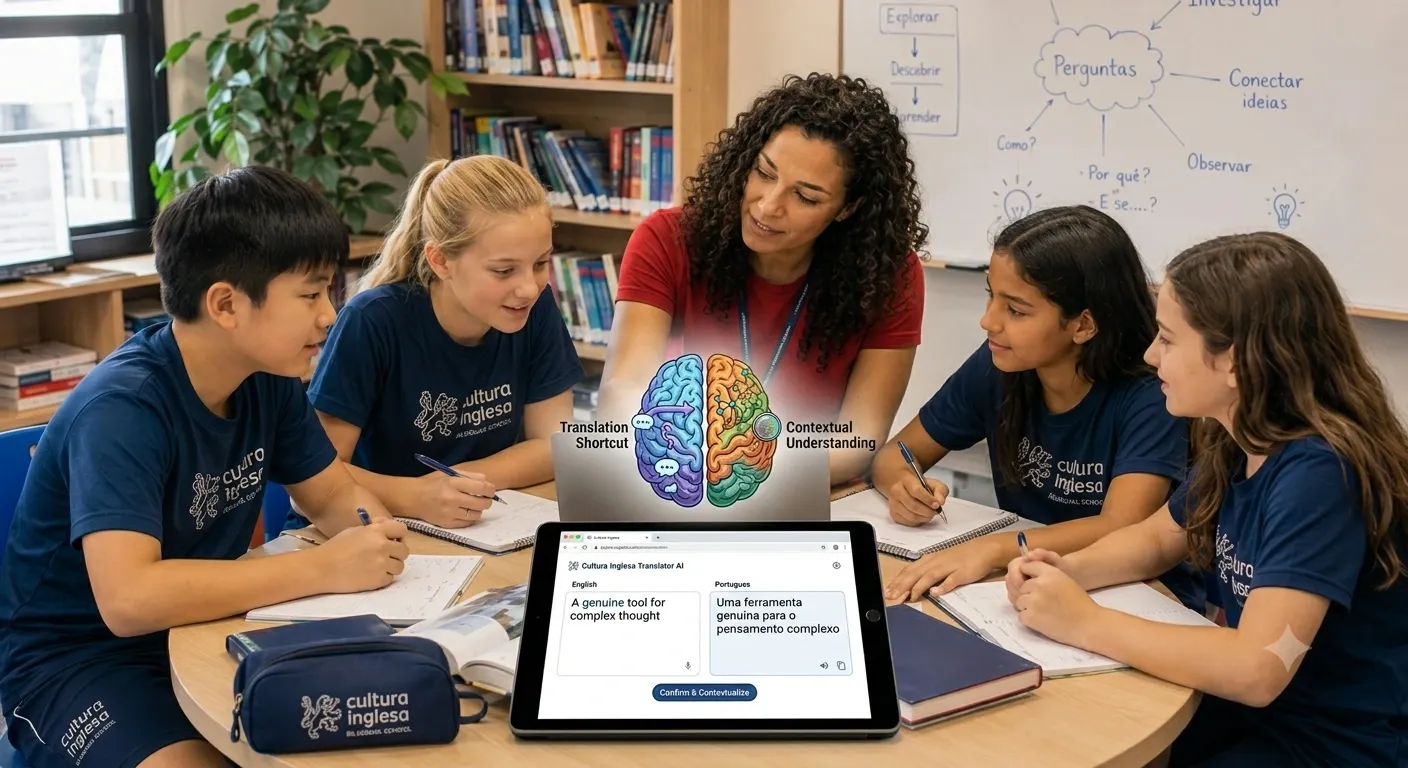
Artificial Intelligence in Schools: A Learning Ally or a Shortcut to Ready-Made Answers?
Artificial Intelligence in Schools: A Learning Ally or a Shortcut to Ready-Made Answers?
Artificial Intelligence at School: Tool or Shortcut?
If a tool can answer in seconds a question that would take minutes to research, what remains essential to learning?
A few years ago, one of schools' great concerns was ensuring access to information. Today, we live in a different reality: we have more information and more ready-made answers than we have ever had.
In just a few seconds, an Artificial Intelligence tool can summarize a book, explain a complex concept, suggest ideas for a project, or write a complete text. Faced with this scenario, an inevitable question arises: if answers are increasingly accessible, what remains essential to learning?
The discussion about Artificial Intelligence in education tends to produce opposing opinions. On one hand, some see technology as a threat to learning. On the other hand, some see it as the solution to all of the school's challenges. Perhaps the most interesting path lies somewhere between these two extremes.
The question is not whether Artificial Intelligence should or should not be present in school. It is already part of students' lives and will continue to be present in their academic and professional futures. The real question is how to use it in a way that expands learning rather than replacing it.
Throughout history, new technologies have transformed the way we learn. The calculator changed the way we perform calculations. The internet expanded access to information. Now, Artificial Intelligence offers new possibilities for researching, organizing ideas, receiving feedback, and exploring different perspectives on a single topic. When used consciously, it can be a powerful tool for learning.
The risk arises when we confuse production with learning.
A student can ask a tool to write a text, solve a problem, or produce a complete assignment. The task may even be handed in, but that does not mean learning has taken place. After all, learning is not merely producing an answer. Learning involves understanding, questioning, analyzing, drawing connections, and making meaning.
The goal of school has never been to produce answers.
The goal of school has always been to develop the capacity to formulate questions, investigate problems, build arguments, evaluate evidence, and make well-founded decisions. And these remain deeply human competencies.
That is why the presence of Artificial Intelligence does not diminish the importance of the teacher. On the contrary.
The more accessible answers become, the more important it is to have someone able to help students ask better questions, make connections, reflect on different perspectives, and give meaning to what they learn.
Technology can offer information. Human mediation remains essential for transforming information into knowledge.
At the same time, Artificial Intelligence invites us to reflect on themes that are increasingly relevant to education: authorship, ethics, and responsibility.
What does it mean to produce a text? How do we use ideas generated by digital tools? How do we acknowledge the contribution of different sources? How do we ensure that technology is supporting learning, rather than replacing the process of thinking?
These questions show that the school's challenge is not only to teach students to use new technologies. It is to help them use them with discernment.
In this context, critical thinking becomes one of the most important competencies of the twenty-first century. Artificial Intelligence can generate fast, sophisticated answers, but it does not replace the human capacity to analyze information, identify biases, consider different perspectives, and exercise judgment.
In a world where access to information is practically unlimited, knowing what to think becomes less important than knowing how to think.
In a school committed to the holistic development of its students, technology is not seen as an end in itself. It is a tool that can broaden learning opportunities, as long as it serves greater goals: curiosity, creativity, reflection, collaboration, and the building of knowledge.
In bilingual contexts, this competency becomes even more relevant. As they navigate between different languages, cultures, and perspectives, students learn to compare information, analyze sources, build arguments, and communicate ideas to different audiences. In a world increasingly influenced by Artificial Intelligence, this ability to think critically across different contexts becomes even more valuable.
Perhaps the question is not whether students should use Artificial Intelligence. The question is whether we are teaching our students to use it intelligently.
Because, in a world where answers are increasingly available, the true differentiator will remain the ability to think critically, act ethically, and ask questions that do not yet have ready-made answers.
After all, the future does not belong to those who merely find answers more quickly; it belongs to those who ask better questions.
To help guide this usage in a healthy and productive way, we have broken down the best practices into what can help study development and what requires extra attention.
🟢 Can help:
AI works incredibly well as a partner for brainstorming and co-creation. Students can use it to:
- Find ideas to start a research project: Excellent for breaking through "blank page syndrome" and taking the first step.
- Review a text that has already been written: Helps polish grammar, cohesion, and clarity in what the student actually produced.
- Explore different perspectives on a topic: A quick way to view a subject from multiple angles.
- Generate questions to dive deeper into a subject: Great for testing one's own knowledge before an exam.
Organize information and create summaries: Simplifies structuring large volumes of content to optimize study time.
⚠️ Requires extra attention:
On the other hand, outsourcing learning to technology poses serious risks to intellectual development. It is crucial to monitor and avoid behaviors such as:
- Copying answers without understanding them: The classic "copy and paste" that leads to zero knowledge retention.
- Submitting a text entirely generated by AI: Besides eliminating writing practice, it erases the student's voice and identity.
- Failing to develop one's own reasoning: A lack of mental effort weakens the ability to solve complex problems in the future.
- Using the tool without fact-checking: AIs frequently make mistakes or fabricate data (so-called "hallucinations"). Verifying sources is a must.
- Believing every answer is correct: Developing critical thinking means questioning and validating what technology delivers, rather than accepting it as absolute truth.
💡 Insight: Technology should be the starting point or the refinement of the study process, but never the final destination. Fostering critical thinking and autonomy remains the best path toward excellent bilingual and global education.
Marina Tiso is the Director of Cultura Inglesa Bilingual School – Vila Mariana. An educator, researcher, and trainer of teachers, she has worked in education for more than two decades, with experience in child development, bilingual education, inclusion, and teacher training. She believes that the role of the school is to nurture curious, reflective students who are prepared to take part actively and consciously in a world of constant change.